
Altadena Now is published daily and will host archives of Timothy Rutt's Altadena blog and his later Altadena Point sites.
Altadena Now encourages solicitation of events information, news items, announcements, photographs and videos.
Please email to: Editor@Altadena-Now.com
- James Macpherson, Editor
- Candice Merrill, Events
- Megan Hole, Lifestyles
- David Alvarado, Advertising



Friday, January 2, 2026
After Hours in the Sky and Scrapped Parade Flyover, B-2 Crew Waited—and Finally Got Their Moment
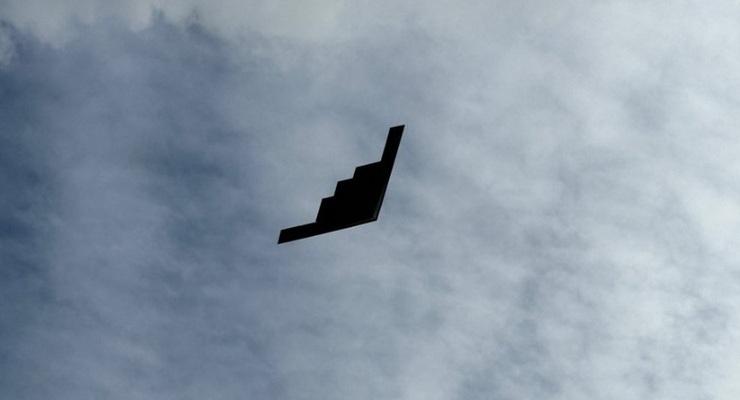
The B-2 Spirit Rose Bowl flyover on Jan. 1, 2026. [Frank Girardot via X]
The stealth bomber was already deep into a 15-hour mission when rain and clouds canceled the Rose Parade flyover. The pilots stayed airborne anyway
Somewhere over the western United States on New Year’s morning, two Air Force pilots sat in the cockpit of a B-2 Spirit stealth bomber, hours into a mission that had begun in the darkness over Missouri, watching the clock tick toward 8:00 a.m. Rose Parade stepoff.
They had already completed multiple mid-air refueling operations—maneuvering their angular, bat-winged aircraft into position behind a tanker at altitude, a task their commander calls “the most challenging kind of hands-on flying event that we do in the B-2.”
Four thousand airmen across 15 squadrons at Whiteman Air Force Base had contributed to the mission that put them in position. The parade route was ready, under low clouds and steady rain. The television cameras were in place. Millions awaited.
But then came the word: Stand down. The clouds were too low. The rain had intesified. Regulations required that spectators be able to see the aircraft in flight above, and on this New Year’s morning, they could not.
For the second time in three years, the Rose Parade would step off without the distinctive silhouette of America’s most advanced bomber overhead. In 2023, the B-2 fleet had been grounded following an emergency landing and runway fire; B-1B Lancers substituted. This time, it was rare bad weather.
But the crew did not turn back to Missouri.
Instead, they remained airborne—Loss management their fatigue through carefully planned rest cycles, returning to the tankers to take on fuel. The outcome was uncertain. The weather might not break. They might fly all day for nothing.
They waited anyway.
“If there’s any chance to do the fly by,” Col. Joshua Wiitala, the 509th Bomb Wing commander, had said before the mission, “we’ll be here to do it.”
Nearly seven hours after the parade stepped off under gray skies, the clouds began to lift over the Rose Bowl. Blue sky appeared. And at approximately 3:00 p.m., as the halftime show concluded and 90,278 spectators looked up from a stadium still damp from nearly 24 hours of steady rain, the B-2 Spirit finally crossed the Southern California sky.
“Undeterred by weather,” Whiteman Air Force Base wrote on social media, “the B-2 Spirit stealth bomber from Whiteman AFB was unable to conduct the Rose Bowl 2026 flyover at the start of the game due to inclement weather. So we kicked off the second half by conducting the flyover at the end of the halftime show.”
The Rose Parade flyover is among the most logistically demanding training missions the Air Force conducts each year—not because of its duration, which is modest by B-2 standards, but because of its precision. The bomber must arrive over the television cameras at Colorado Boulevard at the exact moment the parade steps off, coordinated with a second aircraft scheduled to appear over the Rose Bowl at kickoff. Each jet serves as backup for the other; if one encounters a mechanical problem, the remaining bomber performs both flyovers.
The operation spans virtually every function at Whiteman Air Force Base. Maintenance crews. Mission planners. Tanker squadrons. The logistics chain stretches across hundreds of specialties, all converging on a single objective: put a stealth bomber over Pasadena at a predetermined second.
“From our base in Missouri, we have 4,000 total force airmen, active duty and guard across hundreds of specialties from 15 different squadrons who all have to work in unison to make this mission happen,” Wiitala said before the flight.
And then there is the refueling—repeated throughout the mission, each operation requiring the pilots to guide their aircraft into position behind a tanker and hold steady as fuel flows between two massive machines connected in flight.
“Two big airplanes connected to each other in the sky like that,” Wiitala said. “It takes a lot of training and practice to get good at that. Big airplanes, as you would imagine, have a lot of momentum. You’re always having to think ahead of the airplane.”
On New Year’s Day, the crew executed those operations as planned while waiting for the weather to break—staying ready for a window that might never open.
The tradition they were fighting to preserve dates to 1997, when the B-2 first appeared over the 108th Tournament of Roses Parade as a tribute to the Air Force’s 50th anniversary. It has continued nearly every year since, interrupted only twice: in 2021, when the pandemic canceled the parade itself, and in 2023, when the B-2 fleet was temporarily grounded following a December 2022 emergency landing and runway fire at Whiteman. B-1B Lancers substituted that year.
The flyover carries particular resonance in Southern California. The B-2 was built in Palmdale by Northrop Grumman, just over the mountains from Pasadena, making each New Year’s Day appearance something of a homecoming for an aircraft that first flew in 1989 and entered service the same year the tradition began.
This year’s mission also comes at a moment of transition. The B-2—now nearly three decades in service—is giving way to the next-generation B-21 Raider. The 19 remaining B-2s in the Air Force inventory offer a combination of attributes Wiitala said no other aircraft in the world matches: long range, large payload, and stealth characteristics.
“B-21 is going to modernize all that,” he said, adding that the next-generation bomber will carry forward everything the B-2 community does today to ensure the Air Force remains viable on the long-range strike mission.
How many more Rose Bowls the B-2 will fly over is uncertain. But on Thursday, with the weather finally cooperating and the halftime show ending, the crew that had refused to quit got their moment.
The flyover route this year tracked farther south than in previous years, passing over South Pasadena before turning southwest through Arroyo Canyon, continuing through San Pasqual and East Pasadena into Arcadia, then making a northeast turn toward Monrovia and Duarte along the 210 freeway.
Below, the 112th Rose Bowl Game was unfolding as a historic mismatch. No. 1 Indiana was throttling No. 9 Alabama, 38-3, in a College Football Playoff quarterfinal that produced the first scoreless first quarter the Rose Bowl had seen in 26 years. The pregame pageantry had been curtailed by the weather; both university bands performed from the stands rather than the field, and the traditional procession of Tournament of Roses officials and the Rose Queen had been scrapped.
But when the B-2 crossed the stadium, none of that mattered. The rain had stopped. The sky had cleared. And a crew that had been flying since before dawn—managing fatigue, executing dangerous refueling operations, waiting through hours of uncertainty—finally completed the mission that 4,000 airmen had made possible.
The Air Force rotates pilots for the Rose Parade assignment; Wiitala said he knows of no pilot who has performed it twice.
“We try to rotate around,” he said, “because again, it’s a valuable training opportunity and it’s a cool milestone for those pilots.”
On New Year’s Day 2026, two pilots earned that milestone the hard way—by refusing to give up on it.
Altadena Calendar of Events
For Pasadena Events, click here