Altadena Now is published daily and will host archives of Timothy Rutt's Altadena blog and his later Altadena Point sites.
Altadena Now encourages solicitation of events information, news items, announcements, photographs and videos.
Please email to: Editor@Altadena-Now.com
- James Macpherson, Editor
- Candice Merrill, Events
- Megan Hole, Lifestyles
- David Alvarado, Advertising




Tuesday, March 10, 2026
Pasadena High Schoolers Measure Seismic Waves at Weeknd Concerts — and Present Their Findings to Scientists

Caltech’s free Earthquake Fellows program, now recruiting for 2026, produced research that last summer’s cohort took to a professional conference in Palm Springs
A research team that included Pasadena-area high school students deployed seismometers near SoFi Stadium during The Weeknd’s June concert series last summer, recorded the vibrations that tens of thousands of fans generated, and presented their findings at a professional earthquake science conference in Palm Springs — alongside hundreds of researchers from across the state.
The students are part of the Caltech Earthquake Fellows program, a free research fellowship at Caltech’s Seismological Laboratory that selects about a dozen local sophomores and juniors each summer for roughly 130 hours of seismology immersion on the Pasadena campus. The program is now accepting applications for its 2026 cohort through March 31.
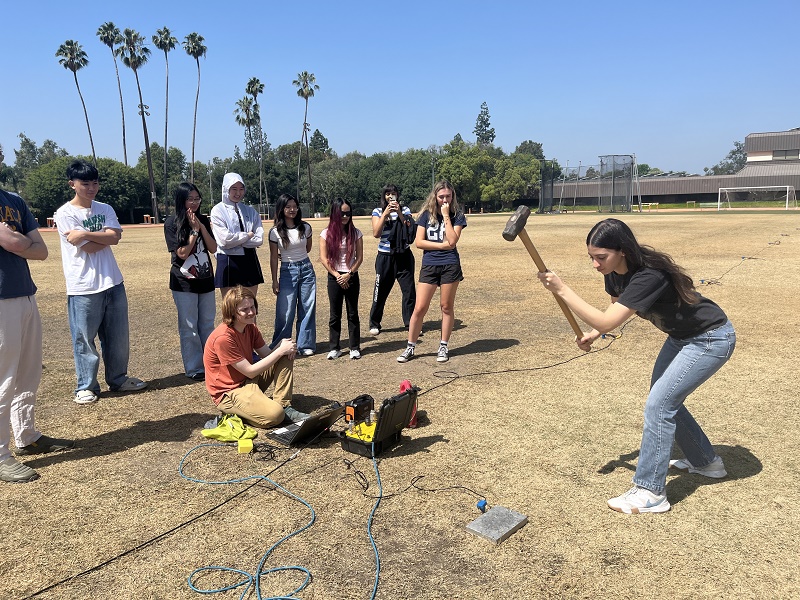
The 2025 cohort — 12 fellows chosen from 53 eligible applicants — produced a poster titled “On the origin of seismic signals from concerts and its potential use to monitor stadium health,” according to the abstract published on the Statewide California Earthquake Center’s website. The team deployed Raspberry Shake seismometers and geophone nodes near SoFi and recorded repeatable seismic signals from all four Weeknd concerts, the abstract states.
Their research found that low-frequency harmonic tremors between 1 Hz and 10 Hz matched the duration of songs and mostly had a frequency of once or twice the tempo of the songs, likely originating from fan movement. Higher-frequency signals above 40 Hz correlated with the music itself and were likely excited by acoustic waves, according to the abstract.
The abstract noted that the stadium might amplify the signal, as suggested by the apparent source location. High-frequency signals were missing from concerts at the nearby Kia Forum, which is more enclosed than SoFi and makes it harder for sound to propagate out, the abstract stated. The researchers concluded that both low- and high-frequency seismic waves are likely modulated by the stadium.
The poster was presented September 7 at the 2025 SCEC Annual Meeting at the Hilton Palm Springs. The students were “some of very few high school students to attend the conference,” said Ariel Raymond, the program’s coordinator at Caltech’s Seismological Laboratory.
The research was co-authored by Shane Zhang, Huiyun Guo, Abellaine Murti, Parisa B. Vazira, Flora Y. Lo, Jacob T. Chow, Raymond, Qiushi Zhai, Igor Stubailo, Gabrielle Tepp, Monica D. Kohler, and Zhongwen Zhan, professor of geophysics and director of Caltech’s Seismological Laboratory, according to the SCEC abstract. Raymond described the results as “so novel and impressive” that the group took the work to the conference.
The abstract noted that because SoFi Stadium will host events during the 2026 World Cup and 2028 Olympics, concert seismic waves might provide a recurring and somewhat repeatable source to monitor the stadium’s health.
The Earthquake Fellows program launched in 2022 with an inaugural cohort of 11 students from Pasadena and Alhambra high schools, developed in partnership between the Seismological Laboratory and the Dr. Lucy Jones Center for Science and Society, a nonprofit. A Caltech news article published September 15, 2022, described the program as working “to strengthen ties between Caltech and surrounding communities and to encourage students, particularly those from underrepresented backgrounds, to pursue scientific careers.”
The 2025 fellows came from Pasadena Unified School District schools — Pasadena High School, John Muir High School, and Marshall Fundamental — as well as schools in Alhambra, Temple City, South Pasadena, and Glendale, Raymond said. PUSD lists the Caltech Earthquake Fellows on its “Available Opportunities” page for students seeking experiential learning.
“Students will build their own Raspberry Shake seismometer, deploy it in their homes (or on location), collect data, and be able to partake in authentic research opportunities,” Raymond said. “They get to keep the Raspberry Shake at the conclusion of the program and we hope it inspires them to continue in research in STEM, but particularly the geosciences,” she said.
Fellows also receive loaned computers and transportation for field experiences, according to a Caltech program announcement published by Pasadena Now on February 23, 2025. Transportation assistance is available for students demonstrating financial need on a case-by-case basis, and the program includes guidance on college applications and financial aid, the announcement stated.
“Many students are also surprised to learn that the program is free!” Raymond said. “They need to get themselves to campus, but otherwise the program has no cost, and the program can help with parking permits for the summer as well.”
“A highlight of every year is a field trip with the GO Outdoors program that takes students around Pasadena, the San Fernando Valley, and up to Mt. Wilson and allows them to see the geological components that relate to the seismology of the area,” Raymond said.
In 2022, Dr. Jodi Marchesso — then principal of Sierra Madre Elementary School and a former PUSD STEM specialist — said the district was “grateful for the robust partnership” with Caltech. “Because of this partnership, our students have the opportunity to contribute to research that has an impact on science,” Marchesso said. “It is experiences like this that create a connection between classroom learning and the world around us.”
“Many students have attested that they are now studying engineering, computer science, geology, and geophysics as a result of participating in this program,” Raymond said. Alumni have gone on to attend college at Cal Poly Pomona, California State University – Los Angeles, UC Berkeley, and California State University, Northridge, she said.
The 2026 program begins with three Saturdays in May starting May 9, runs Monday through Friday from June 22 to July 17, and concludes with two Saturdays in August, Raymond said. The culminating event is Saturday, August 15, when fellows present their summer research. Applicants must have completed three years of high school mathematics or up to and including Integrated Math III, according to the 2025 Caltech program description. Students and parents can direct questions to Raymond at araymond@caltech.edu. Applications close March 31.
“I think it’s good to have outreach programs to bring students who don’t grow up in that environment into the fold and encourage them to do STEM,” said Jimmy Atterholt, a graduate student who mentored the inaugural cohort in 2022.
Altadena Calendar of Events
For Pasadena Events, click here