Altadena Now is published daily and will host archives of Timothy Rutt's Altadena blog and his later Altadena Point sites.
Altadena Now encourages solicitation of events information, news items, announcements, photographs and videos.
Please email to: Editor@Altadena-Now.com
- James Macpherson, Editor
- Candice Merrill, Events
- Megan Hole, Lifestyles
- David Alvarado, Advertising



Friday, December 26, 2025
A Kwanzaa Tradition Returns ‘Home,’ Carrying Light Through Uncertain Times
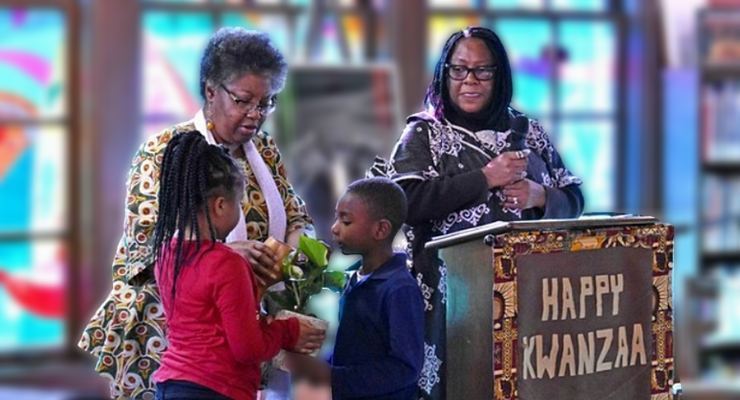
Sanifu Adetona and Thanayi Karenga, daughter of Maulana Karenga, the creator of Kwanzaa, stand with two children during a previous Pasadena Kwanzaa celebration at the La Pintoresca Branch of the Pasadena Public Library on December 27, 2018. [Pasadena Now photo]
From 11 a.m. to 1 p.m. on Saturday, December 27, Pasadena’s 37th Annual Kwanzaa Celebration will take place inside the meeting room of the La Pintoresca Branch Library, marking the event’s return to its traditional venue.
Pasadena’s annual Kwanzaa celebration was first held in 1989. The event has been held at La Pintoresca Branch Library for much of its history, moved online during the COVID-19 pandemic, and was relocated to the Jefferson Branch Library in 2023 and 2024.
Saturday’s celebration is organized by the Pasadena Alumnae Chapter of Delta Sigma Theta Sorority, Inc., in partnership with the Pasadena Public Library, and will honor Kujichagulia — self-determination — the second principle of Kwanzaa, observed on the holiday’s second day.
The event is free and open to the public, with no prior registration required.
Its program follows a structure established over decades, including a traditional libation ceremony honoring ancestors; the lighting of candles on the kinara; storytelling; youth presentations; music; and the distribution of books to children as zawadi, or gifts.
“It’s a time for us to really try to maintain unity in the family, in the community, in the nation and in the race,” said Esther Sherrod Watkins, a retired educator and co-chair of the Kwanzaa committee, in earlier conversation with Pasadena Now. “Also to strengthen our ties, our bonds, and … each other.”
For organizers, the celebration represents a return to the venue that long served as the event’s home.
The Pasadena Alumnae Chapter of Delta Sigma Theta Sorority, chartered in 1961, has been a central organizer of the celebration since its early years. Over more than six decades of service in Altadena and Pasadena, the chapter has distributed more than $515,000 in academic awards and maintained a focus on educational development, civic service, and community advancement.
The annual Kwanzaa celebration aligns with the sorority’s Five-Point Program Thrust, which includes economic development, educational development, international awareness and involvement, physical and mental health, and political awareness and involvement.
“The community looks forward to this each year because it’s a connection with our heritage and our culture,” Watkins said. “Each principal has a good meaning and it’s very important for today’s society, particularly for young people, to understand.”
Kwanzaa was created in 1966 by Dr. Maulana Karenga following the Watts uprising in Los Angeles. Conceived as a cultural — not religious — observance, the holiday spans December 26 through January 1 and draws on African harvest traditions. Each day focuses on one of the Nguzo Saba, or Seven Principles: Umoja (unity), Kujichagulia (self-determination), Ujima (collective work and responsibility), Ujamaa (cooperative economics), Nia (purpose), Kuumba (creativity), and Imani (faith).
The official Kwanzaa theme is “Practicing the Seven Principles in Dimly-Lit Times: Lifting Up the Light, Hurrying the Dawn.” The theme addresses what Dr. Karenga describes as “the thick fog of falsehood, fear, chaos, confusion and uncertainty that has emerged in this historical moment,” and calls for the Seven Principles to serve as guiding lights for unity and resilience.
On December 27, the Pasadena celebration will focus on Kujichagulia, defined within Kwanzaa tradition as the commitment “to define ourselves, name ourselves, create for ourselves, and speak for ourselves.”
“We must learn to create for ourselves and to continue to speak for others when they cannot speak for themselves and help to build and make our communities and families stronger,” Ms. Watkins said.
The program will include live music by Brother Yusef, a blues musician who describes his style as “Fattback Blues,” a funk-based approach shaped by more than 25 years as a professional performer.
In addition to music and storytelling, youth presentations remain a core element of the celebration, reflecting its emphasis on intergenerational participation. Previous celebrations have featured children as young as seven years old. Cultural elements of the program also include the display of traditional Kwanzaa symbols, such as the kinara, black, red and green candles, and muhindi, or corn, representing children and future generations. A traditional tribute honoring family members who have passed is also part of the observance. Refreshments will be served as part of the karamu, or feast.
Kwanzaa begins nationally on December 26 with Umoja and concludes on January 1 with Imani, faith. Pasadena’s celebration takes place on the second day of the holiday.
As Watkins described it, the purpose of the annual gathering remains consistent.
“It’s a connection with our heritage and our culture,” she said. “Each principal has a good meaning.”
Altadena Calendar of Events
For Pasadena Events, click here