Altadena Now is published daily and will host archives of Timothy Rutt's Altadena blog and his later Altadena Point sites.
Altadena Now encourages solicitation of events information, news items, announcements, photographs and videos.
Please email to: Editor@Altadena-Now.com
- James Macpherson, Editor
- Candice Merrill, Events
- Megan Hole, Lifestyles
- David Alvarado, Advertising



Monday, August 31, 2026
Guest Opinion | Robert Staehle, Lori Paul: Piecemeal, Costly Board of Forestry Regulations Fail to Significantly Reduce Fire Risk: We Need a Different Approach.
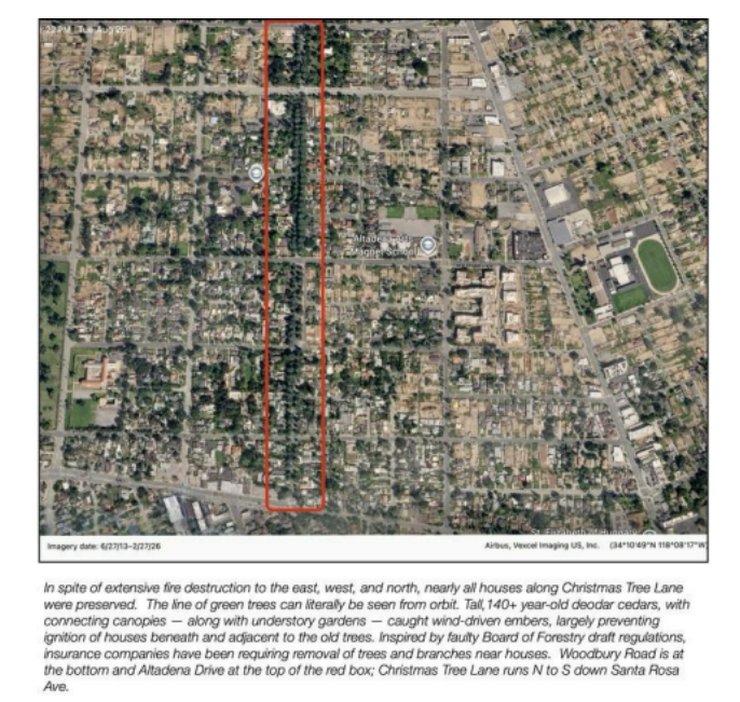
We live in a designated Very High Fire Hazard Severity Zone (VHFHSZ). We support this designation, which is based on reality. You may not live within a VHFHSZ; however, the massive devastation in the Eaton and Palisades fires foretell a VHFHSZ in your future.
We need an affordable approach to preventing, mitigating, and recovering from future wildfires. For those in designated “very high hazard” areas, the Board of Forestry (BofF) has issued new, counterproductive “Zone 0” regulations that will be very costly, damaging to our properties, and that may actually increase fire risk.
Even if you have a bed of high-moisture succulents and similar plants that protected your house from embers along walls during the Eaton Fire, the new regulations say you will have to remove those plants within 5 feet of your home. Same goes for a green hedge that may have protected your house… and privacy. And for trees that shade and cool your home, requiring additional A/C costs.
The new regulations fail to consider what your house is made of: Cinder block, concrete, and other fireproof materials, such as steel roofs, require the same plant removals, replaced by heat-radiating gravel, rocks, or concrete.
At the last minute, the Board of Forestry, following 18 months of refusing to discuss the cost of implementing their regulations, now claims that the average homeowner will “only” spend $960.54 to comply with Zone Zero regulations. You can’t get an estimate for the $40.51 BofF suggests for Tree Maintenance. Their estimated costs for removing or severely pruning trees, taking out hedges and other garden plants, purchasing rock or concrete for around the house and more… go beyond unrealistic.
What is missing most is a broader approach, beyond the scope of BofF’s jurisdiction. What about the 2011 building code requirement that all new homes have indoor sprinklers? They won’t keep an outside fire from burning your home, but they add $10s of thousands to the rebuild cost for homes. Most Altadena houses were built before any such requirement. Altadena’s current water providers cannot possibly create enough new reservoir and water main capacity to supply even a fraction of the houses that burned in the Eaton Fire with the water flow needed to operate all triggered indoor sprinklers. In the next major wildfire, after setting off the first few hundred house sprinkler systems as homes ignite, water supplies would run dry for other houses and firefighters alike.
Instead of costly indoor sprinklers, homeowners and businesses should be given an option for installing a utility-independent external roof sprinkler system, fed from grey-water and/or rainwater collected in cisterns, rain barrels, or gravity-fed tanks, with pumps powered by batteries that operate even when the grid shuts down. At least if an outdoor system gets triggered, it won’t soak and ruin all your furniture, carpets, other belongings, and grow mold in your walls. It would likely stop the fire from entering and consuming your home.
All over Altadena, we see new houses being built of flammable plywood and 2x4s identical to what burned. We applaud the few builders who appear capable of building with reinforced concrete and steel using fire- and earthquake-resistant approaches. What will it take to raise the fraction of houses that are rebuilt of fire-resistant materials?
Rather than the ongoing, piecemeal approach of the Board of Forestry to fire prevention, we need multidisciplinary, coordinated action that can generate highly complex problem solutions, similar to methods used by NASA / Jet Propulsion Laboratory’s (JPL) Team X, and Caltech’s Keck Institute of Space Studies (KISS). Gather a focused group of experts from all relevant disciplines, coming from a wide variety of non-profit organizations across academia and government, where they can debate and share expertise to develop innovative fire-prevention strategies based on their special disciplines and experiences. Assignment:
Bring together all relevant disciplines, advise the best approaches for California, including local jurisdictional autonomy, for preventing devastating wildfires along with supporting community and victim recovery after future fires such as those that devastated Altadena and the Pacific Palisades, including:
- Preserving human life and long-term health.
- Reducing the number of structures damaged or destroyed by fire and associated floods and landslides, including residential neighborhoods and commercial districts; recreational parks, roads, and other infrastructure.
- Reducing damage to the natural environment, including: wildlife, tree canopy; wildlands; streams and watersheds.
- Ensuring affordability of measures taken by and for property owners; renters; local businesses; municipalities; mutual, government-owned and investor-owned utilities; and other districts and jurisdictions.
- Increasing the effectiveness of immediate firefighting approaches, emergency victim warnings; and disaster aid.
- Following wildfires and other disasters with well-organized responses: including speed, affordability, and support for those lowest on the economic tiers and highest in vulnerability, to assure the most rapid and complete recovery possible; including swift insurance claim payments.
- Proposing legislative, regulatory, and policy changes that can enable and establish these specified needs.
We respectfully submit that the above approach — instead of the current stand-alone, damaging, costly, and less effective Board of Forestry “emergency Zone 0” regulations — will provide a vastly better approach to prepare for future wildfires and other disasters.
Robert Staehle
Lori Paul
Eaton Fire Survivors
Altadena Calendar of Events
For Pasadena Events, click here