Altadena Now is published daily and will host archives of Timothy Rutt's Altadena blog and his later Altadena Point sites.
Altadena Now encourages solicitation of events information, news items, announcements, photographs and videos.
Please email to: Editor@Altadena-Now.com
- James Macpherson, Editor
- Candice Merrill, Events
- Megan Hole, Lifestyles
- David Alvarado, Advertising



Thursday, July 23, 2026
Four Myths About Insurance In California
By Levi Sumagaysay, CALMATTERS
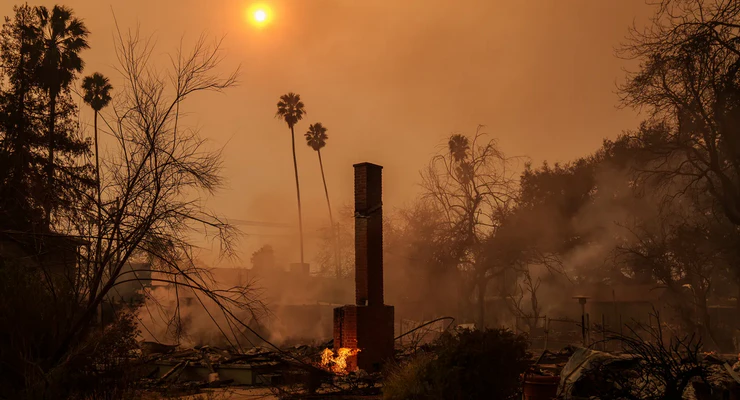
A fireplace remains standing from a home that was burned down by the Eaton Fire in the Altadena and Pasadena area on Jan. 8, 2025. Photo by Jules Hotz for CalMatters
Many Californians have seen rising costs, less availability and are running into other issues with insurance — including delays and denials of their claims — in the past several years.
As climate change increases the risk of wildfires and other disasters, it’s important to know how insurance plays a role. The health of the insurance market affects the ability of individuals and communities to replace, rebuild and recover after a catastrophe.
Disasters aside, property insurance affects where people live, how neighborhoods are formed, whether people can drive to work, and more.
As the state’s residents prepare to vote for a new insurance commissioner in November, here’s a look at a few common myths about insurance in California.
MYTH: Only homeowners and wealthy people should care about the state’s insurance issues.
FACT: Almost everyone needs insurance, including landlords, renters and small business owners. Anyone who drives needs auto insurance.
About 44% of the state’s residents do not own their homes, according to the U.S. Census Bureau. But their landlords have been dealing with increased insurance costs in the past several years, with some of them telling CalMatters that they have passed some of those costs along to renters.
The state does not require renters to buy their own insurance, although some landlords require tenants to get renters insurance. Consumer advocates recommend that renters have insurance in case they have to find an alternate place to live after a fire or other disaster.
Other providers of rental housing are also running into insurance-availability issues, which could affect housing supply.
A high-cost state like California needs all the affordable housing it can get. Affordable housing owners and operators say some insurance companies have moved away from offering insurance to commercial properties, including affordable housing units. Some of them have had to turn to “non-admitted” insurance companies, which are not licensed and regulated by the state — and not backed by the state if they go bankrupt. Some operators have had to tap their reserves to cover the increasing costs of insurance. They typically do not pass those costs along to renters because affordable-housing rules limit how much rent they can charge. Besides, they know their renters have limited incomes.
“If organizations have to come out of pocket to cover premiums, it’s just not sustainable,” said Erich Nakano, director of special projects for Little Tokyo Service Center, a Los Angeles community development group that owns more than 1,000 affordable housing units across different properties in the area.
Meanwhile, auto insurance premiums in California are among the highest in the nation. The insurance industry has said that’s due in part to growing disaster risks, as well as higher costs for replacing parts or repairing vehicles. Unlike housing or rentals — where people who don’t have a mortgage need not have insurance, and not all renters must buy coverage — everyone who wants to drive is legally required to have insurance.
MYTH: California’s insurance issues are all state lawmakers and regulators’ fault.
FACT: Many other states are dealing with higher insurance costs and availability problems. Climate change has sparked and worsened different kinds of natural disasters, such as hurricanes in Florida and tornadoes in Texas.
California’s voter-approved insurance law, Proposition 103 from 1988, is often a scapegoat for people frustrated by the state’s insurance market problems. Insurance is overregulated and the state should just let the free markets reign, the law’s critics say.
But low-regulation states like Florida continue to have issues with insurance affordability; its average home insurance premiums are the most expensive in the United States, according to the Insurance Information Institute, an industry group. Meanwhile, because of Prop. 103 and its provision that the Insurance Department must approve rate increases, California’s home insurance premiums rank somewhere in the middle.
As for other problems, like glacial insurance-claim processing or claim denials, the state’s elected insurance commissioner gets a lot of pressure to make those disappear. Some — such as survivors of the deadly Los Angeles County fires last year — have placed the blame squarely on Ricardo Lara, whose term is set to end this year. They called on him to resign.
A couple of insurance experts who are also consumer advocates said there is no “magic wand” that can make the insurance industry be as responsive as their customers want them to be, and no easy fixes for the other issues plaguing insurance markets everywhere.
“(Fire survivors) have the right to be angry about the impact of industry trends on them,” said Amy Bach, executive director of consumer advocacy group United Policyholders. But the insurance department’s authority over industry trends and practices — such as the number of adjusters that might be assigned to a claim — is limited, she said.
Lara’s department eventually found that State Farm, the biggest insurer in California, violated laws in its handling of claims from the L.A.-area fires. A yet-to-be-scheduled hearing before an administrative law judge will determine whether to impose the penalties suggested by the department.
Altadena Calendar of Events
For Pasadena Events, click here