
Altadena Now is published daily and will host archives of Timothy Rutt's Altadena blog and his later Altadena Point sites.
Altadena Now encourages solicitation of events information, news items, announcements, photographs and videos.
Please email to: Editor@Altadena-Now.com
- James Macpherson, Editor
- Candice Merrill, Events
- Megan Hole, Lifestyles
- David Alvarado, Advertising



Friday, January 2, 2026
Altadena Homes Face Lingering Indoor Smoke Hazards After Wildfires, Newly-Published UCLA Study Finds
BASED ON A STORY BY CITY NEWS SERVICE
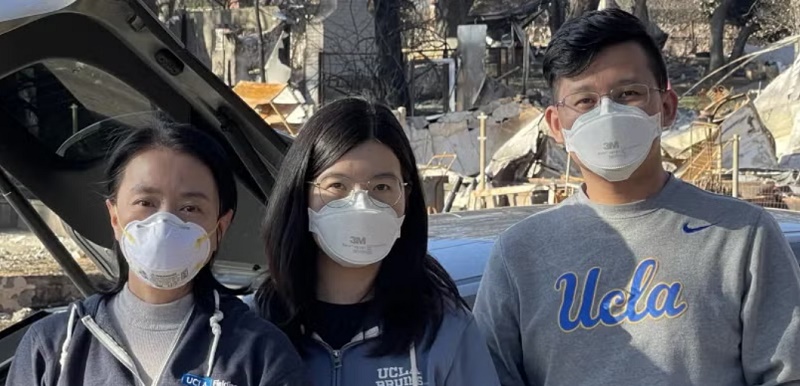
From left to right, Dr. Yifang Zhu, Dr. Yuan Yao, and Dr. Haoxuan Chen, during field work research into the presence of volatile organic compounds in the aftermath of the 2025 Los Angeles County wildfires. Photo credit: UCLA.
Homes in the Altadena-Pasadena foothills continued to pose air?quality risks long after the January 2025 wildfires were extinguished, with some residents potentially exposed to elevated levels of carcinogenic pollutants after returning, according to a UCLA study released Friday.
Researchers with the UCLA Fielding School of Public Health found that in some homes within burn zones, levels of certain volatile organic compounds, or VOCs, were higher during the post?fire recovery period than while the fires were actively burning.
The study, published in Environmental Science & Technology Letters, examined indoor and outdoor air quality during and after the January 2025 wildfires in the Pacific Palisades-Malibu area and the Altadena-Pasadena foothills.
The findings suggest that smoke?impacted building materials and household items continued releasing harmful pollutants over time.
“These findings underscore the need for targeted interventions to minimize indoor exposures during the recovery phase,” Dr. Michael Jerrett, a professor of environmental health sciences at UCLA Fielding and a co?author of the study, said in a statement. “These findings raise concerns about indoor air quality post?wildfire, and the potential for prolonged exposure leading to significant health impacts.”
The January fires in Altadena, Pasadena and the Palisades killed at least 31 people, burned more than 37,000 acres and damaged or destroyed more than 18,000 structures, according to Los Angeles County estimates. Both blazes ignited Jan. 7, spread rapidly into residential neighborhoods and were finally fully contained by Jan. 31.
Researchers began collecting air samples on the second day of the fires and continued through Feb. 18, measuring concentrations of VOCs such as benzene, toluene, ethylbenzene and xylenes — chemicals known to be released when household materials burn.
“In these cases, the indoor concentrations during active fires remained comparable to outdoor levels, indicating that staying indoors did not fully prevent exposure to fire?related pollutants,” said Dr. Yuan Yao, the study’s lead author.
“This indoor/outdoor pattern shifted during the post?fire recovery phase, likely driven by off?gassing from smoke?impacted materials, which highlights the potential for prolonged indoor VOC exposure — even after outdoor fire activity subsides.”
The study found that staying indoors during the fires did not fully protect residents from exposure, with indoor VOC levels often similar to those measured outdoors.
Researchers recommended steps such as increasing ventilation, operating heating and air?conditioning systems with high?efficiency filters and using portable air purifiers with charcoal filtration to help reduce exposure.
The study is part of the ongoing Los Angeles Fire Human Exposure and Long?Term Health Study.
Altadena Calendar of Events
For Pasadena Events, click here